

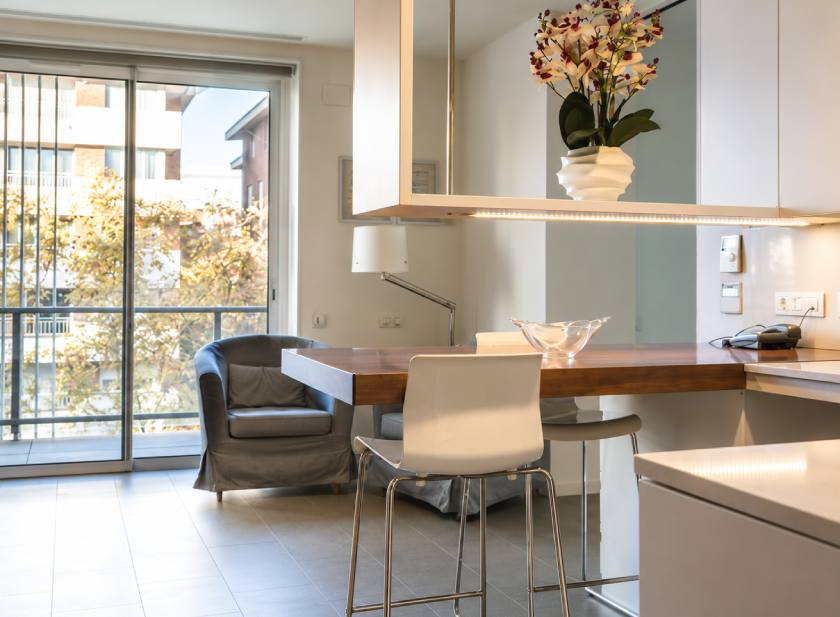
When looking for accessible long stays in Barcelona, the priority is not only to find a safe place, but also a space where you can maintain your independence in everyday life. Living independently means being able to prepare your own meals, organise your daily routine and have access to real support whenever you need it. At MICs Sant Jordi, we understand that an extended stay in the city requires much more than an apartment with ramps: it needs to be a home designed around you, where every detail contributes to your wellbeing and personal freedom.
Barcelona is a vibrant city with access to specialised medical treatments, cultural activities and an inclusive community. However, finding adapted accommodation that allows you to live independently for several months is not always easy. That is why there are solutions specifically designed for people with reduced mobility who want to enjoy a long stay without giving up their independence.
Independence at home: beyond ramps and wide doors
Independence in an accessible home goes far beyond basic physical accessibility. Although wide doors, spacious corridors and step-free access are essential, true independence comes when the space allows you to carry out everyday activities without constantly relying on other people.
In an adapted apartment for long term stays, this means being able to move around freely, having spaces designed with your comfort in mind and access to assistive equipment that makes everyday life easier. Adjustable beds, for example, are not a luxury: they allow you to adjust the height and position independently, which can be essential for people with reduced mobility. Likewise, strategically positioned safety rails, spacious lifts and sufficient turning space for wheelchairs transform an apartment into a place where you can truly live, rather than simply stay.
Independence also has an emotional dimension. Living in an accessible environment means being able to make decisions about your daily life without constantly having to negotiate with your surroundings. It means choosing when to get up, what to have for breakfast and how to organise your time without every movement requiring a complicated adjustment.
The accessible kitchen: at the heart of independence
One of the most transformative aspects of an accessible long stay is having a truly functional kitchen. An accessible kitchen for people with reduced mobility is both an attractive space and a place where you regain control over your diet, habits and daily routine.
An adapted kitchen should meet several essential requirements. Worktops should be positioned at an accessible height so they can be used whether you are sitting or standing. Appliances—such as the refrigerator, oven and washing machine—should be within easy reach without requiring difficult stretching or bending. Circulation space is equally important: you need enough room to manoeuvre a wheelchair, access cupboards and work comfortably.
Beyond technical specifications, however, being able to cook in your own apartment during a long stay represents freedom. It means preparing meals according to your dietary preferences, cultural habits or simply what you feel like eating at that moment. Not having to depend on catering services or predetermined menus is an aspect of independence that many people take for granted, but one that becomes especially important when you have reduced mobility.
In adapted apartments for long stays, kitchens include accessible lower cupboards, refrigerators with easy-opening doors and workspaces with enough room for utensils and small appliances that make food preparation easier. Some accommodation options also provide assistance with grocery shopping or meal preparation if needed. This means you always retain control over your own decisions.
Adapted daily routines: structure and freedom
Living in accessible long-stay accommodation in Barcelona means being able to establish routines that work for you. Unlike a short stay, where everything is temporary, a long-term stay allows you to develop everyday patterns that support your physical and emotional wellbeing.
Daily routines in an adapted apartment are built around your own pace. You may need time for physiotherapy in the morning, or perhaps you prefer to do mobility exercises in the afternoon. Your routine might include social activities, visits for medical treatment or periods of rest. The key is that a well-designed apartment allows you to organise your day without having to struggle against the environment.
Adapted bathrooms are essential for everyday routines. A level-access shower, strategically positioned grab bars and enough room to manoeuvre can make personal hygiene safer and more independent. Some apartments include shower chairs and accessible shower systems that make this daily activity much easier to manage. Similarly, bedrooms with adjustable beds allow different positions to be set to improve rest and help prevent health problems related to posture.
Daily routines also benefit from complementary services. A 24-hour reception, cleaning of common areas and access to assistive equipment such as spare wheelchairs or orthopaedic equipment allow you to focus on what really matters: your recovery, your wellbeing and your personal goals during your stay in Barcelona.
Support services: the perfect complement to your independence
Support services for people with disabilities in adapted accommodation are not a sign of dependence, but rather a valuable complement to your independence. The key difference is that these services respond to your needs without taking control away from you when making decisions.
During an accessible long stay, support services may include personalised assistance available according to your schedule, help with specific household tasks, medication management if required, or transport coordination so that you can attend medical treatments and activities in Barcelona. Some accommodation providers also offer support in organising accessible activities around the city, which can be especially valuable if you are visiting Barcelona for tourism or health-related reasons.
What matters is that these services adapt to you, rather than the other way around. If you require 24-hour assistance, it should be available. If you prefer greater independence and only need occasional support, that should also be possible. This flexibility is what transforms accommodation into a truly inclusive housing solution.
In addition, many adapted apartments for long stays include access to specialist services such as on-site physiotherapy or an adapted swimming pool. These resources can support your physical health while also contributing to your emotional and social wellbeing during an extended stay in the city.
Designed for people with reduced mobility
Apartments adapted for accessible long stays in Barcelona are designed according to specific criteria that go beyond what you might find in a conventional hotel. Every detail matters: from door widths to the height of light switches, from the layout of the space to the positioning of safety rails.
Apartment sizes vary depending on your needs. Options range from individual 33-square-metre apartments to larger spaces of 51 or 62 square metres, ideal if you are travelling with a carer or as part of a group. This range allows you to choose the space you actually need, without paying for unnecessary floor space or compromising on comfort.
The assistive equipment provided—including transfer hoists, trapeze bars, strategically positioned safety rails, shower chairs and adjustable beds—is designed for people with conditions such as ALS, multiple sclerosis or Ehlers-Danlos syndrome. This means the apartment is not only accessible in theory, but equipped to support the everyday needs of people with different types of disabilities.
Barcelona as a destination for accessible long stays
Location is essential when looking for accessible long stays in Barcelona. The city offers good connections via accessible public transport, access to specialised medical centres and a growing range of cultural and inclusive activities. Whether you are coming for medical treatment, recovery or simply to enjoy the city, Barcelona has a great deal to offer.
Adapted apartments are strategically located to provide easy access to the city centre, hospitals and clinics, as well as essential services. This convenient location means that you are not isolated on the outskirts of the city, but integrated into everyday urban life in Barcelona.
Taking the next step: how to choose your accessible long stay
When looking for an accessible long stay in Barcelona, it is important to understand exactly what each accommodation option provides. Check the specific dimensions of doors and spaces, ask for real photographs of the adapted kitchen and bathroom, and obtain written confirmation of the assistive equipment included. You should also ask about the support services available and how they can be adapted to your schedule and individual needs.
Not all accessible long-stay accommodation is the same. The difference between an apartment that is simply “accessible” and one genuinely designed around independence lies in the details: whether the kitchen allows you to cook properly, whether everyday routines can be carried out without constantly depending on other people, and whether support services respect your independence.
Living in Barcelona for an extended period should be an enriching experience in which you retain control over your life. You deserve a space that allows you to remain independent, respects your dignity and makes it possible for Barcelona to truly become your temporary home, rather than simply a place where you wait for time to pass.
If you are looking for an accessible long stay in Barcelona where you can live with genuine independence, at MICs Sant Jordi we design each apartment with your independence and wellbeing in mind. Contact us today to learn more about our adapted accommodation options and discover how we can make your stay in Barcelona safe, comfortable and independent. Our team is available to answer any questions you may have and help you find the right space for your needs.